


Construction estimating has always required discipline, trade knowledge, and calm judgment under pressure. Every bid carries responsibility. Every number must account for labor, materials, equipment, subcontractor scope, project conditions, exclusions, alternates, and the actual cost of completing the work.
That responsibility has become harder to manage.
Modern drawing sets are larger. Specifications are more detailed. Addenda move quickly. Delivery models often create overlapping scopes and unclear responsibilities between trades. Bid timelines continue to tighten, while margins leave little room for missed work or weak assumptions.
The issue is not that estimators lack skill. The issue is that manual review has limits when document volume, schedule pressure, and scope complexity rise simultaneously.
AI construction estimating software is becoming useful because it supports the parts of the workflow where manual processes are most exposed. It can assist with takeoffs, compare drawings and specifications, review revisions, identify missing scope, and flag possible contradictions before a bid is submitted.
The strongest tools do not replace estimators. They strengthen the estimator’s ability to see the project clearly. The goal is not only speed. The goal is a more accurate, complete, and defensible estimate.
Where Traditional Estimating Workflows Break Down
Traditional estimating workflows rely on manual takeoffs, spreadsheets, personal checklists, trade experience, subcontractor input, and internal review. Those tools still matter. Skilled estimators remain essential because they understand constructability, production rates, sequencing, scope boundaries, and market conditions.
The challenge is that traditional workflows can become fragile under modern project conditions.
A requirement may appear in the specifications but not in the drawings. A detail may change in an addendum after the takeoff has already started. A scope item may be implied in one discipline but assigned unclearly in another. A finish schedule, equipment note, general requirement, or coordination detail may affect pricing without being obvious during a fast review.
These issues often hide between documents. They are rarely presented as simple errors.
Estimators respond with discipline. They compare documents, ask questions, mark up plans, build scope sheets, review exclusions, and rely on lessons learned from past work. Still, compressed bid cycles force prioritization. Teams have to decide where to direct attention first, and some risks remain buried until after the award.
That is where estimating risk grows. Missed scope can lead to change orders, margin loss, rework, disputes, and difficult conversations with owners or trade partners.
A defensible estimate depends on more than measured quantities. It depends on whether the team understands the full scope, the gaps in the documents, and the assumptions behind the final number.
What AI Really Means For Construction Estimating
AI in construction estimating is often misunderstood. It is not a black box that should produce a final bid without human review. It is not a shortcut around accountability. Construction-focused AI is better understood as a review and intelligence layer.
It helps teams analyze drawings, specifications, annotations, schedules, symbols, revisions, and historical project patterns. It can compare information across documents and surface issues that deserve attention.
That may include missing scope, inconsistent notes, quantity anomalies, unclear trade responsibility, specification conflicts, or project requirements that are easy to overlook during manual review.
This is different from generic automation. A basic takeoff tool may count doors, measure walls, calculate areas, or extract quantities. AI plan review goes further by comparing document intent across disciplines. The construction scope review goes further still by asking whether the estimate reflects the work required by the project.
The estimator remains in control. Human professionals still determine pricing, productivity, subcontractor strategy, qualifications, inclusions and exclusions, and the final risk posture.
The value is focus. Instead of spending every hour manually searching for potential problems, estimators can spend more time evaluating the issues most likely to affect the bid.
From Faster Takeoffs To Stronger Scope Understanding
Early construction estimating automation focused heavily on speed. That made sense. Quantity takeoff can be repetitive, time-consuming, and vulnerable to fatigue. Digital tools helped teams move faster than paper-based processes.
Speed alone does not solve the hardest estimating problems.
A fast takeoff can still miss an exclusion. A clean quantity list can still ignore a specification requirement. A spreadsheet can still carry an outdated assumption into the final bid. A measurement can be correct while the scope behind it remains incomplete.
Modern AI estimating tools are more valuable when they connect speed with understanding. Automated takeoff software helps produce quantities. AI-assisted review helps determine whether those quantities are connected to the full project scope.
That shift changes the purpose of estimating technology. The goal is not simply to finish faster. The goal is to submit a stronger bid with fewer hidden weaknesses.
For general contractors, that may mean reviewing subcontractor scopes with better visibility. For specialty contractors, it may mean protecting trade boundaries and catching work that could otherwise be missed. For preconstruction managers, it may mean creating a more consistent review process across teams.
Scope Gap Detection And Cross-Document Review
Scope gaps are one of the most expensive sources of construction estimating risk. They occur when required work is missing, unclear, duplicated, incorrectly excluded, or assigned without sufficient coordination.
They are also difficult to catch manually.
A scope gap may appear between architectural and structural drawings. It may sit between mechanical coordination and general requirements. It may involve temporary work, access panels, penetrations, firestopping, insulation, controls, blocking, excavation, cleanup, protection, closeout documents, or trade-specific support work.
These items may not look large during bid review. They can become expensive when they affect responsibility, sequencing, pricing, or change order exposure.
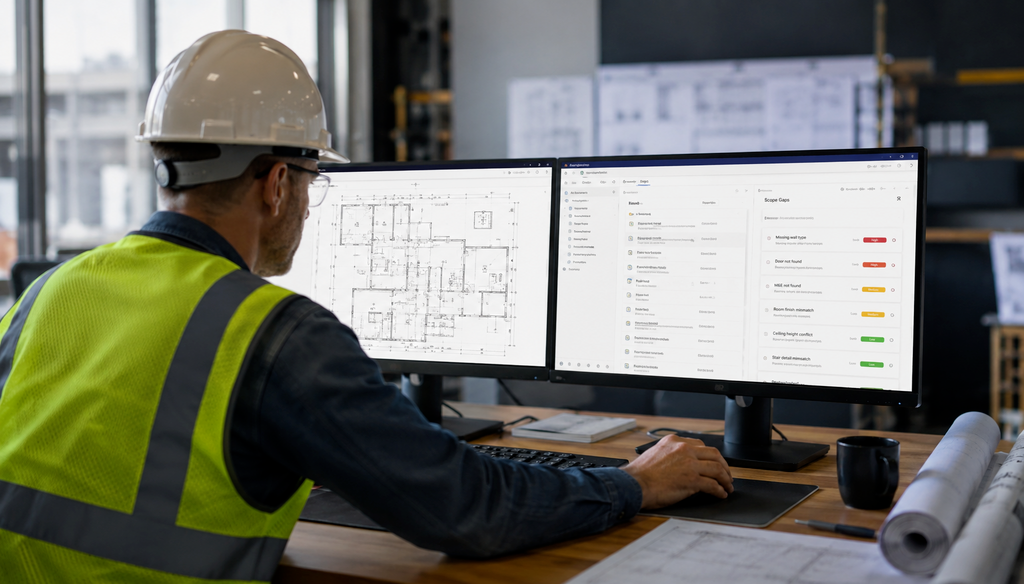
AI scope gap detection helps teams compare project documents for missing or misaligned work. It can review drawings against specifications, compare one discipline to another, and flag items that appear in one place but not another.
That support is especially useful during bid preparation. Estimators can review flagged gaps, decide whether to include the work, ask for clarification, qualify the bid, or discuss responsibility with subcontractors.
Scope gap detection also helps create more defensible estimates. A team can show where a risk was identified, which document created the concern, and how the issue was handled. That documentation supports internal review and clearer communication with stakeholders.
For a deeper look at this shift, see this guide on AI construction estimating.
AI Makes Defensible Estimates More Practical
A defensible estimate is not just a number with backup. It is an estimate built from visible logic, documented scope, reviewed assumptions, and clear treatment of risk.
AI helps make that standard more practical on real bid timelines.
When project documents are reviewed more consistently, teams can catch issues earlier. When a missing scope is flagged, estimators can decide how to handle it before submission. When contradictions are documented, bid qualifications become more precise. When historical patterns are available, the team becomes less dependent on a single person to remember every lesson from past work.
This is where construction estimating automation becomes more than a productivity gain. It becomes a margin protection tool.
The benefit is not that AI makes estimating effortless. Construction will always require judgment, accountability, and careful review. The benefit is that AI helps teams spend more time on decisions that require expertise and less time searching manually for every possible gap.
A better bid starts before the number is finalized. It starts with clearer information, stronger review, and fewer hidden assumptions.
What Is AI In Construction Estimating?
AI in construction estimating refers to software that uses artificial intelligence to review project documents, assist with takeoffs, compare drawings and specifications, identify missing scope, and support more accurate bid preparation. It can analyze patterns across documents and highlight risks that may be difficult to catch manually under deadline pressure.
Does AI Construction Estimating Software Replace Estimators?
No. AI construction estimating software supports estimators rather than replacing them. Estimators still make the final decisions about pricing, labor, production rates, subcontractor strategy, bid qualifications, and project risk.
How Does AI Improve Construction Estimating Accuracy?
AI improves the accuracy of construction estimating by comparing drawings, specifications, notes, schedules, and revisions for potential omissions or contradictions. It can flag missing scope, quantity anomalies, unclear responsibilities, and specification requirements that may affect pricing.
What Is Scope Gap Detection In Construction?
Scope gap detection is the process of finding missing, unclear, duplicated, or misaligned work in construction documents and estimates. These gaps often occur between drawings, specifications, addenda, and trade scopes.
How Is AI Different From Automated Takeoff Software?
Automated takeoff software focuses mainly on measuring and counting quantities from plans. AI construction estimating software may include takeoff support, but it can also review context, compare documents, detect missing scope, and flag bid risk.
Can AI Review Construction Drawings And Specifications Together?
Yes. Purpose-built AI plan review tools can compare drawings and specifications together. This is useful because many estimating issues occur between documents rather than inside a single sheet.
What Should Contractors Look For In AI Construction Estimating Software?
Contractors should look for software that understands construction documents, supports scope-gap detection, provides traceable results, integrates with existing preconstruction workflows, and helps estimators quickly verify issues. The best tools strengthen human review rather than hide risk behind automated output.
