


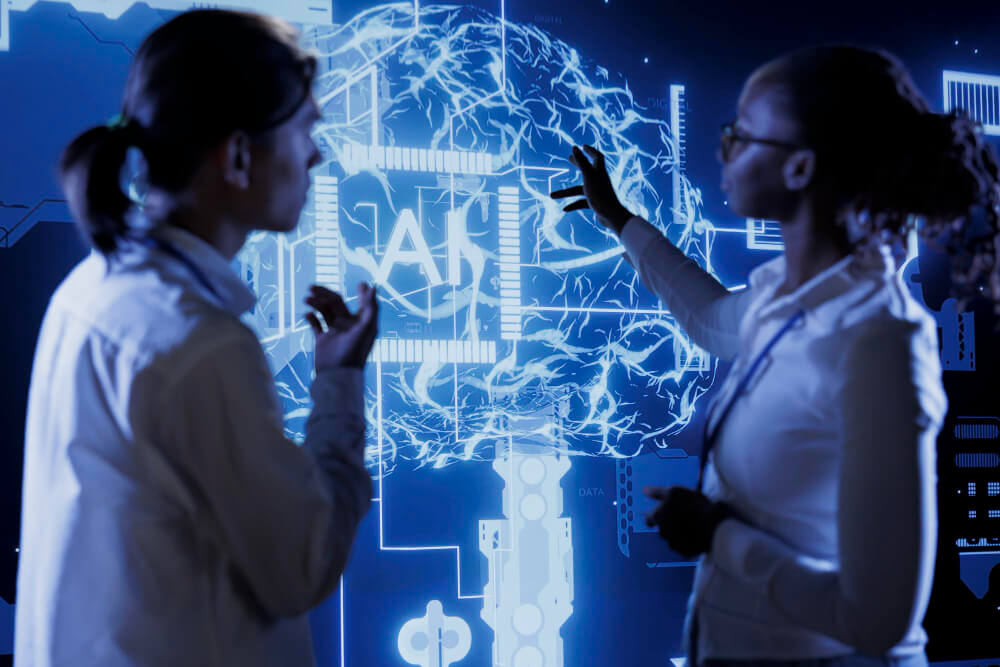
Generative AI refers to a subset of artificial intelligence that focuses on creating new content or data that resembles existing data. It employs machine learning models, particularly neural networks, to generate outputs such as images, text, or designs that mimic human creativity. By learning patterns and structures from the input data, generative AI systems can produce novel solutions that often exceed human capabilities in terms of speed and complexity.
One of the key concepts in generative AI is the use of Generative Adversarial Networks (GANs). GANs consist of two neural networks—the generator and the discriminator—competing against each other. The generator creates new data instances, while the discriminator evaluates them for authenticity. This adversarial process refines the generator’s ability to produce increasingly convincing outputs, thereby enhancing the quality of the generated content. Variational Autoencoders (VAEs) and Transformer models are also pivotal in the realm of generative AI, each contributing uniquely to the generation process.
Generative AI is not just a technological advancement; it is a paradigm shift in how industries, including manufacturing, approach problem-solving and innovation. It empowers machines to transcend traditional programming constraints by generating solutions autonomously. This capability has profound implications for industries like manufacturing, where complex processes and customization are essential. The technology enables manufacturers to optimize production lines, design innovative products, and enhance supply chain efficiency with unparalleled precision and speed.
How Generative AI is Revolutionizing Manufacturing Processes
Generative AI is transforming manufacturing by introducing efficiencies and innovations previously thought unattainable. One of the most significant impacts is in product design and development. With generative AI, manufacturers can create designs optimized for specific functions and constraints, leading to lighter, stronger, and more cost-effective products. AI-driven design tools analyze millions of design permutations to propose the most efficient structures, reducing material waste and production costs.
Another revolutionary application of generative AI in manufacturing is predictive maintenance. By analyzing vast amounts of machine data, AI models can predict equipment failures before they occur, allowing for preemptive maintenance scheduling. This reduces downtime and extends equipment life, significantly impacting a manufacturer’s bottom line. Moreover, AI-driven insights enable manufacturers to optimize their inventory management by predicting demand patterns and adjusting supply chains accordingly.
Generative AI also plays a crucial role in enhancing manufacturing processes through automation and robotics. AI-powered robots can adapt to changes in the production line in real-time, increasing flexibility and efficiency. They are capable of performing complex tasks that require precision and adaptability, such as assembling intricate components or managing quality control. This level of automation reduces human error and increases production speed, ultimately leading to higher productivity and improved product quality.
For more informstion you can find here on how generative AI is revolutionizing the manufacturing industry and to explore in-depth resources, research studies, and expert insights, to continue your journey into the future of manufacturing. Stay ahead of the curve and join the community of innovators embracing the power of AI in industry transformation.
