


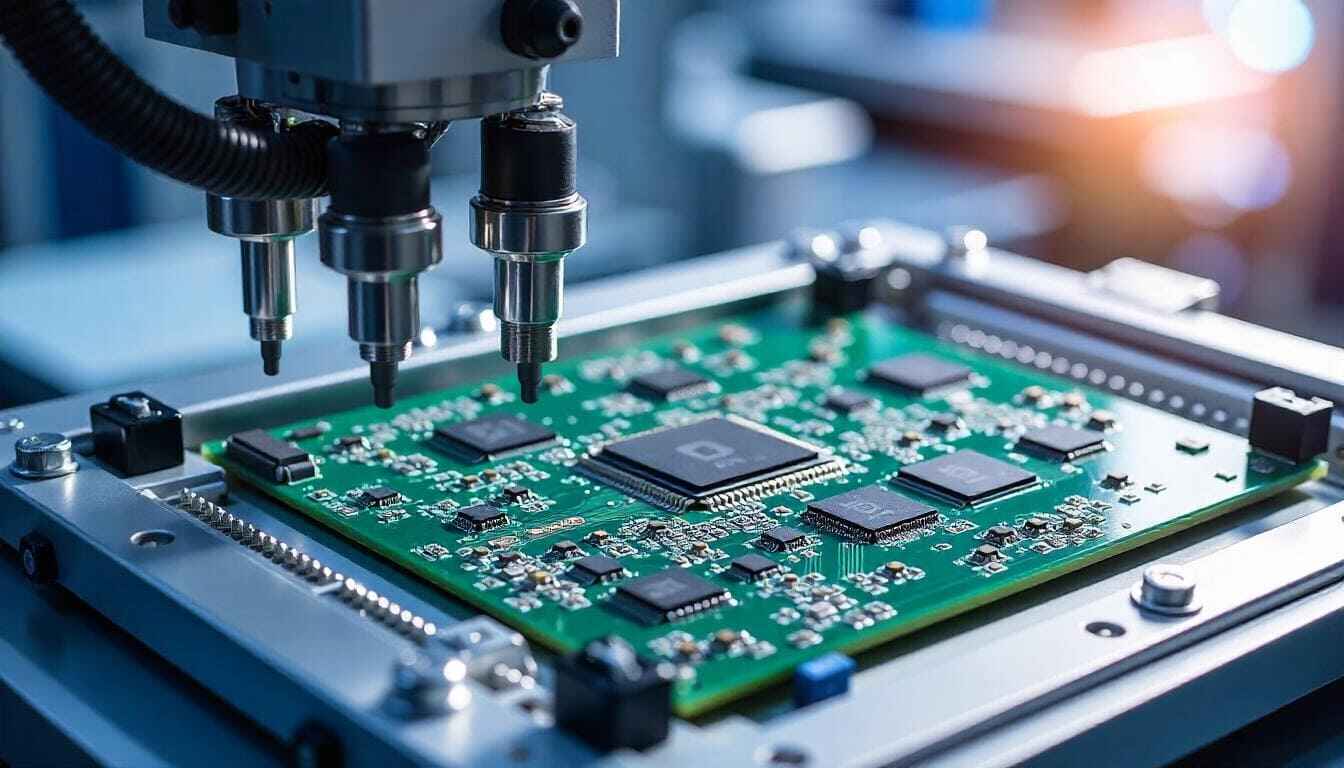
If you’ve ever cracked open a piece of electronics — a phone, a laptop, a TV remote, a microwave — you’ve seen a printed circuit board. That flat green (or sometimes black, blue, or red) board covered in silver traces, tiny components, and mysterious markings is the backbone of almost every electronic device ever made. But what actually is a printed circuit board, how does it work, and why do engineers spend so much time obsessing over them?
Here’s a straightforward guide that doesn’t assume you have an electrical engineering degree.
What Is a Printed Circuit Board?
A printed circuit board — PCB for short — is a flat board that mechanically supports and electrically connects electronic components. The “printed” part refers to the copper traces that are etched or deposited onto the board’s surface using a process that originally resembled printing. Those traces are the highways that carry electrical signals and power between components.
Before PCBs existed, electronics were built using point-to-point wiring — components soldered directly to each other or to terminal strips with individual wires running between them. It worked, but it was slow to build, difficult to troubleshoot, and nearly impossible to mass produce consistently. The PCB solved all of those problems at once and made modern consumer electronics possible.
Today, virtually every electronic device you own contains at least one PCB. Your smartphone has several.
What’s a PCB Actually Made Of?
The most common PCB material is FR4, a fibreglass-reinforced epoxy laminate. It’s rigid, electrically non-conductive, reasonably heat-resistant, and cheap to manufacture in large quantities. That green colour most people associate with circuit boards actually comes from the solder mask — a protective coating applied over the copper — not the base material itself.
A typical PCB is a layered sandwich. At its most basic, a 2 layer board has:
The substrate — the FR4 fibreglass core that gives the board its structure
Copper layers — thin sheets of copper laminated onto one or both sides of the substrate, etched into the trace patterns that form the circuit
Solder mask — a polymer coating over the copper that protects traces from oxidation and prevents solder bridges during assembly
Silkscreen — the white (or sometimes yellow) printed layer on top that shows component labels, logos, pin markings, and other reference information
More complex boards have additional copper layers sandwiched inside the substrate — 4, 6, 8, or even more layers for dense, high-performance designs.
How Does a PCB Actually Work?
At its core, a PCB is just a very organised, very precise wiring system. The copper traces act like wires, connecting one component to another according to the circuit schematic the designer created. Components are soldered onto the board at specific pads — small areas of exposed copper — and once everything is in place, electricity flows through the traces between them.
What makes a PCB powerful is the combination of precision and repeatability. Every trace on every board in a production run is identical. Every component sits in exactly the right place. The physical layout of the board can also be engineered to improve performance — keeping noisy digital signals away from sensitive analog circuits, matching trace lengths for high-speed signals, or providing a solid ground plane that reduces interference.
That’s a level of control you simply can’t achieve with hand-wired point-to-point construction.
Types of PCBs
Not all circuit boards are built the same way. The right type depends on the application.
Single layer PCBs have copper on one side only. They’re the simplest and cheapest to manufacture and are used in straightforward, low-cost applications like basic power supplies, LED lighting, and simple controllers.
Double layer (2 layer) PCBs have copper on both sides, connected by small drilled holes called vias. This dramatically increases routing flexibility and is the standard choice for the vast majority of hobbyist and commercial designs.
Multilayer PCBs have additional copper layers buried inside the board. 4 layer boards are extremely common in consumer electronics and add dedicated ground and power planes that improve signal integrity and reduce electromagnetic interference. High-end devices like smartphones, computers, and networking equipment often use 8, 12, or more layers.
Flexible PCBs use a flexible polymer substrate instead of rigid fibreglass, allowing the board to bend or fold. They’re used in applications where the board needs to fit into tight or irregular spaces — inside a camera, wrapped around a wearable device, or connecting moving parts.
Rigid-flex PCBs combine rigid and flexible sections in a single board, giving designers the best of both worlds for complex mechanical and electrical requirements.
Through-Hole vs. Surface Mount Components
How components attach to a PCB has changed significantly over the decades, and understanding the difference matters if you ever look at a board up close.
Through-hole components have wire leads that pass through drilled holes in the board and are soldered on the opposite side. They’re robust, easy to hand-solder, and good for high-stress mechanical applications. Older electronics used through-hole almost exclusively, and it’s still common for connectors, large capacitors, and components that need to handle significant mechanical force.
Surface mount components (SMD) sit directly on pads on the board surface with no holes required. They’re smaller, lighter, cheaper to place robotically, and allow components on both sides of the board. The vast majority of modern electronics are assembled almost entirely with surface mount components. Some of them are astonishingly tiny — barely visible to the naked eye.
Most real-world boards use a mix of both, with SMD components handling the bulk of the circuitry and through-hole reserved for connectors and anything that needs extra mechanical strength.
How PCBs Are Manufactured
The PCB manufacturing process with a company like Avanti Circuits, is a fascinating combination of chemistry, precision machining, and photographic techniques.
It starts with the copper-clad laminate — a sheet of FR4 with copper bonded to its surface. The desired circuit pattern is transferred onto the copper using a photosensitive film and UV light exposure process, then the unwanted copper is chemically etched away, leaving only the traces. Holes are drilled for vias and through-hole components, the copper is plated to improve conductivity and durability, and then the solder mask and silkscreen layers are applied.
For multilayer boards, individual layers are manufactured separately, then precisely aligned and laminated together under heat and pressure before drilling and finishing.
The whole process is highly automated and has become remarkably affordable. Prototype boards that would have cost hundreds of dollars to produce twenty years ago can now be manufactured for a few dollars each at scale.
Why PCB Design Is Harder Than It Looks
Looking at a finished PCB, it’s easy to assume the design process is mostly about drawing neat lines between components. The reality is considerably more complex.
A PCB designer has to think simultaneously about electrical performance, thermal management, signal integrity, electromagnetic compatibility, mechanical constraints, manufacturing tolerances, and assembly requirements. A trace that’s too thin will overheat under load. A trace that’s too long will introduce signal delay. Components placed too close to each other can cause interference. Poor ground plane design can turn an otherwise solid circuit into an antenna for noise.
Good PCB layout is genuinely skilled work, and the difference between a thoughtfully designed board and a carelessly designed one can mean the difference between a product that works reliably and one that fails in the field.
The Bottom Line
Printed circuit boards are so fundamental to modern electronics that it’s easy to take them for granted. But behind every working device is a board that someone carefully designed, a manufacturer that produced it to tight tolerances, and an assembly process that placed hundreds or thousands of components exactly where they need to be.
Whether you’re curious about the technology inside your gadgets, thinking about designing your own board, or evaluating PCBs as part of a product development process, understanding the basics of what a PCB is and how it works gives you a genuine edge. It’s one of those topics that rewards even a surface-level understanding with a much clearer picture of how the modern world actually functions.
