


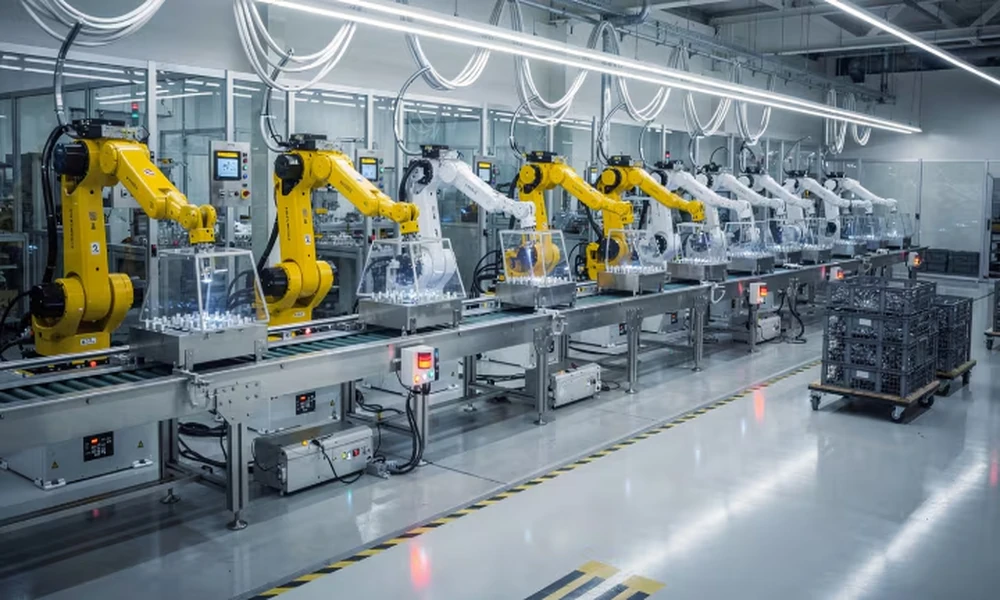
Automation gets sold as a technology decision and is almost always a throughput decision. A manufacturer does not want a machine; they want to fill four hundred pails a shift instead of a hundred and eighty, with fewer spillages and one operator instead of three. Assessing advantech singapore automation options for a filling and packaging line starts from that operational arithmetic rather than from a specification sheet.
Identify the Actual Constraint
Every line has one bottleneck, and investing anywhere else changes nothing. If filling is the constraint, a faster filler helps. If the constraint is capping, or palletising, or the single operator moving empty containers to the line, a faster filler simply builds a larger queue in front of the next station. Walk the line and time each stage before specifying anything. The exercise takes a day and regularly redirects a capital decision to somewhere cheaper and more effective.
The Stations That Make Up a Line
A typical liquid packaging line runs in sequence, container denesting or feeding, filling, capping or sealing, labelling, then palletising. Each can be manual, semi-automatic or fully automatic, and they do not all have to be at the same level. Many operations run an automatic filler with manual palletising and get most of the benefit. Deciding station by station, rather than automating everything at once, spreads capital and lets each change prove itself.
Matching the Filler to the Product
The product determines the filling method more than anything else. Thin, free-flowing liquids suit gravity or flow-meter filling. Viscous products such as oils, resins and pastes need positive displacement, typically piston or lobe pump systems. Foaming products need bottom-up diving nozzles that fill beneath the surface. Corrosive or solvent-based products dictate wetted-part materials and seal compatibility. Give any supplier the viscosity, temperature, foaming tendency and chemical characteristics before discussing machines.
Weight or Volume
Filling by volume is simpler and suits products with consistent density. Filling by weight, using load cells under the container, compensates automatically for density variation with temperature and batch, and is generally more accurate. Where product is sold by weight and giveaway matters, the weigh-fill route usually pays for itself, since consistently overfilling by even one percent across a year is a substantial quantity of product given away without being invoiced.
Container Handling
Containers arrive nested or stacked and have to reach the filling head oriented and singulated. A denester separates and places them automatically, which removes a genuinely tedious manual task and is often the cheapest meaningful improvement on a semi-automatic line. Beyond that, conveyor design, guide rails and stopping arrangements determine whether the line runs smoothly or jams every few minutes. Suppliers of industrial filling and packaging equipment should be specifying the handling around the machine, not just the machine.
Changeover Time Is a Hidden Cost
A machine that runs at high speed and takes ninety minutes to change between container sizes can be slower over a week than one that runs slower and changes in ten. Ask specifically how a changeover is performed, how many parts are swapped, whether tools are required, and whether settings are stored in a recipe or dialled in manually. For operations with many SKUs and short runs, changeover time frequently matters more than nominal throughput.
Safety and Compliance
Machinery guarding, emergency stops, interlocks and safe access for cleaning and maintenance are requirements rather than options, and workplace safety obligations here place responsibility on the occupier. Where flammable solvents are handled, area classification and equipment rated for the environment become central to the specification. Establish this early, because a machine specified without regard to the atmosphere it will work in cannot be retrofitted into compliance cheaply.
Integration With Existing Equipment
Very few projects start with an empty floor. Most involve adding a station to a line that already exists, which raises questions a standalone specification never addresses. Do the conveyor heights match, and if not, who supplies the transition? Will the new control system talk to the existing one, or will an operator be watching two separate panels? Is there spare electrical capacity and compressed air of sufficient quality and volume? Is there physical room, including access for maintenance and for a pallet truck? Answering these before ordering avoids the familiar situation where a machine arrives correct in every respect and cannot be connected to anything.
Support Matters More Than Specification
A filling line that stops costs production every hour it is down. Ask where spare parts are held, what the response time is for a breakdown, whether technicians are locally based, and what a service contract covers. Ask what training is provided and to how many staff, since a machine that only one operator understands is fragile in a way no specification sheet reveals. These questions distinguish suppliers more reliably than throughput figures do.
Building the Business Case
Quantify the current position honestly, units per shift, labour on the line, spillage and giveaway, rework and downtime. Then quantify the same figures with the proposed change and calculate a payback period. Include installation, commissioning, training and the production lost during changeover to the new arrangement. Approached this way, advantech singapore automation becomes a decision you can defend with numbers rather than a purchase justified by the sense that the line ought to be faster.
