


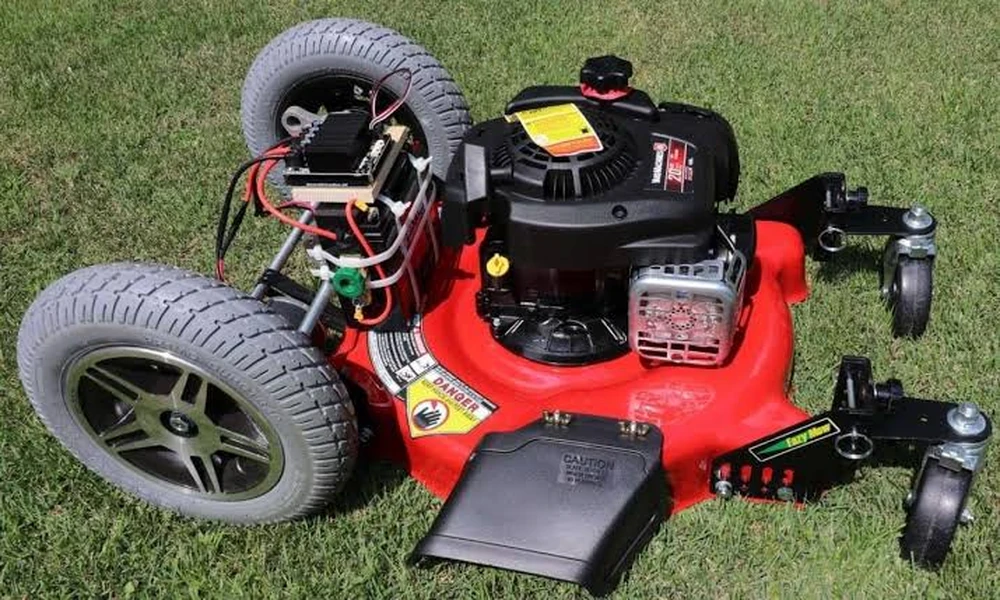
Not every lawn is flat. For homeowners managing properties with significant slopes – embankments, hillsides, tiered gardens, or simply ground that falls away steeply at the boundaries – conventional mowing is not just inconvenient. On gradients above a certain steepness, it becomes genuinely hazardous. A conventional walk-behind mower on a steep slope puts the operator in contact with terrain that can cause slipping, and the mower itself can become unstable.
The remote control lawn mower was developed specifically to address this problem. By removing the operator from the immediate vicinity of the cutting equipment on difficult terrain, remote controlled mowing makes slopes that were previously awkward or dangerous to maintain much more manageable. The machine works the slope; the operator stands on safe ground and directs it.
Understanding Slope Ratings
RC mowers designed for slope work are typically rated by the maximum gradient they can handle, expressed either in degrees or as a percentage. A 45-degree slope is extremely steep – close to the limit of what a person can comfortably stand on. Most residential slopes fall well below this, which means that a mower rated for 45 degrees will handle the vast majority of domestic gradient situations without reaching its limits.
The slope rating reflects the maximum gradient the drive system can maintain traction and control on, which depends on several factors: the weight distribution of the machine, the grip of the wheels or tracks, the power of the drive motors, and the control systems that keep all four drive points engaged appropriately. A higher slope rating generally reflects better engineering across all these factors, not just a more powerful motor.
Wheel Drive vs Track Drive
For serious slope work, track drive systems offer significant traction advantages over wheeled alternatives. Tracks distribute the machine’s weight over a larger surface area, reduce ground pressure, and maintain contact with irregular terrain more consistently than wheels. The tradeoff is increased mechanical complexity and potentially higher maintenance requirements.
For moderate slopes – up to around 30 degrees – a well-designed four-wheel drive system performs very adequately. The RC mower category includes both wheeled and tracked options at various price points, with tracked models generally occupying the higher end of the market and offering the best performance on the most challenging terrain.
Managing Long Grass on Slopes
Slopes often have longer, denser grass than flat sections of the same garden – partly because they are harder to access and partly because the cutting height that works on flat ground sometimes scalps the high points on uneven slope terrain. Managing this requires a combination of the right cutting height setting and appropriate mowing technique.
On a remote controlled mower, cutting height is adjusted in the same way as a conventional mower – a mechanical setting on the cutting deck. For slopes with uneven surface, raising the cutting height provides a margin that prevents the deck from digging in on high spots while still cutting the grass effectively. Starting at a higher setting and gradually reducing it over several sessions allows you to manage long grass without overloading the motor or leaving an uneven result.
Safety Advantages for Slope Mowing
The safety case for RC slope mowing is straightforward. When the operator is not on the slope, the risks associated with conventional slope mowing – slipping, the mower rolling, contact with the cutting blade in a fall – are eliminated from the human side of the equation. The machine can slide, stall, or have an issue on the slope without putting anyone at physical risk. This is not a marginal benefit; it is a meaningful safety improvement for anyone maintaining steep terrain regularly.
